OSHA sanitation rules under 29 CFR 1926.51 require one toilet for 20 or fewer workers and two toilets for 20 to 200 workers, so a framing crew of 15 on a South Tacoma infill build needs one unit while a 40-person…
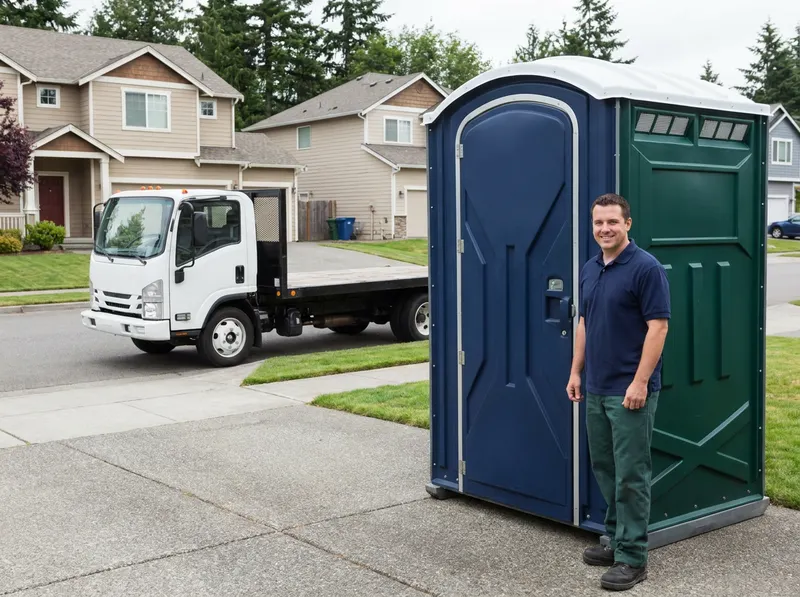
OSHA sanitation rules under 29 CFR 1926.51 require one toilet for 20 or fewer workers and two toilets for 20 to 200 workers, so a framing crew of 15 on a South Tacoma infill build needs one unit while a 40-person concrete pour on the Eastside needs two. Weekly service is the standard interval for construction: a technician pumps the holding tank, hoses the interior, restocks paper, and tops off the sanitizer once every 7 days. High-traffic sites of 30-plus workers or two-shift schedules often move to twice-weekly service to keep the 60-gallon tank from filling early.
Standard non-flush units measure roughly 48 inches square and 90 inches tall and fit on a curb, a gravel staging area, or a compacted dirt pad. They anchor upright in the wind coming off Commencement Bay and the Foss Waterway when set on level ground; placement on a slope or loose fill requires a firm base. ADA-compliant units are wider, about 62 inches square, with a ground-level entry and interior grab bars, which matters on public-works and prevailing-wage jobs near Wright Park or along Ruston Way where inspectors check accessibility. Flushing units with a foot pump and a self-contained handwash station suit trades handling drywall mud, epoxy, or food-service fit-outs where hand-washing is frequent.
Site access shapes the delivery. Tight lots in the Proctor District and North End with narrow alleys need a placement spot the service truck can reach within a hose length, generally 25 feet. Hilltop and Stadium District projects with street-side placement may fall under a City of Tacoma right-of-way permit if the unit sits on a sidewalk or in a parking lane; a unit on private property inside the fence line needs no permit. For phased builds in Central Tacoma, Old Town, Northeast Tacoma, and the West End, units can be relocated on site as the work zone moves, and relocations are scheduled with the same route.
Choosing the configuration follows the crew and the contract. If the site is a short residential remodel with fewer than 20 workers and no accessibility clause, one standard unit on weekly service is the fit. If the job is a multi-story commercial build or a prevailing-wage public project, pair a standard unit with an ADA unit to meet inspection. If workers handle food, medical, or fine finishes and need running water, the flushing handwash combo is the fit, the trade-off is a higher monthly rate and a larger footprint against cleaner hand hygiene on site.
Every job gets a firm, written price after a free on-site visit.
Tell us about your construction site portable toilet rental job in Tacoma and we'll send a clear, written quote, usually the same day.
 Mount Rainier Portable Toilet Rental